
Running a Sex Offender Check in Talladega County
The official starting point is the Alabama Law Enforcement Agency Sex Offender Registry. ALEA maintains the public system, while local law enforcement registers people and forwards current facts, photos, fingerprints, and address changes. The state says local submissions update the registry daily in real time. That division of work matters. ALEA controls the statewide display, but a question about a possibly wrong Talladega County address belongs first with local law enforcement.
Use the registry for awareness, not as a full criminal case index. Statutory exclusions keep some juvenile, Youthful Offender, and out-of-state matters from public view. A missing listing does not prove that no sex-offense case exists. Court records answer a different question, while the registry shows only those entries Alabama law makes public.
The ALEA registry guidance explains this state and local relationship.
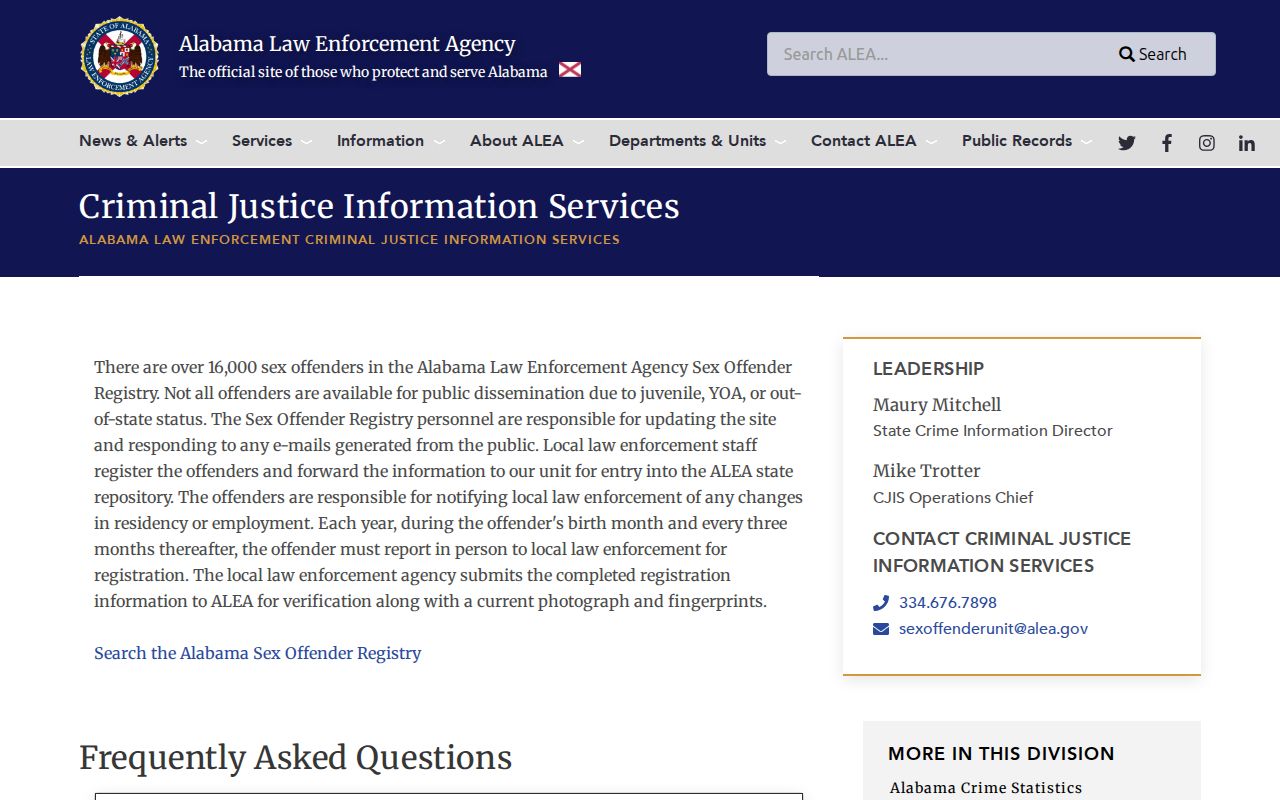
That guidance is the best place to confirm current registry scope before interpreting a Talladega County result.
Talladega County Registry Search Paths
Alabama law requires public search paths by name, city or town, county, ZIP code, and geographic radius. Those choices serve distinct needs. A county filter gives broad Talladega County coverage. A city or ZIP search narrows a known area. A radius search supports awareness around a chosen point, while a name search works best when the person is already known.
The linked vendor interface blocked automated review, so exact radius values and button text should not be guessed. Open it through ALEA's official hub and follow the live labels. No fee or login is indicated in the research. If the interface is unavailable, the ALEA Community Information Center provides the state entry point.
A view of the Community Information Center shows where Alabama directs the public for community information.
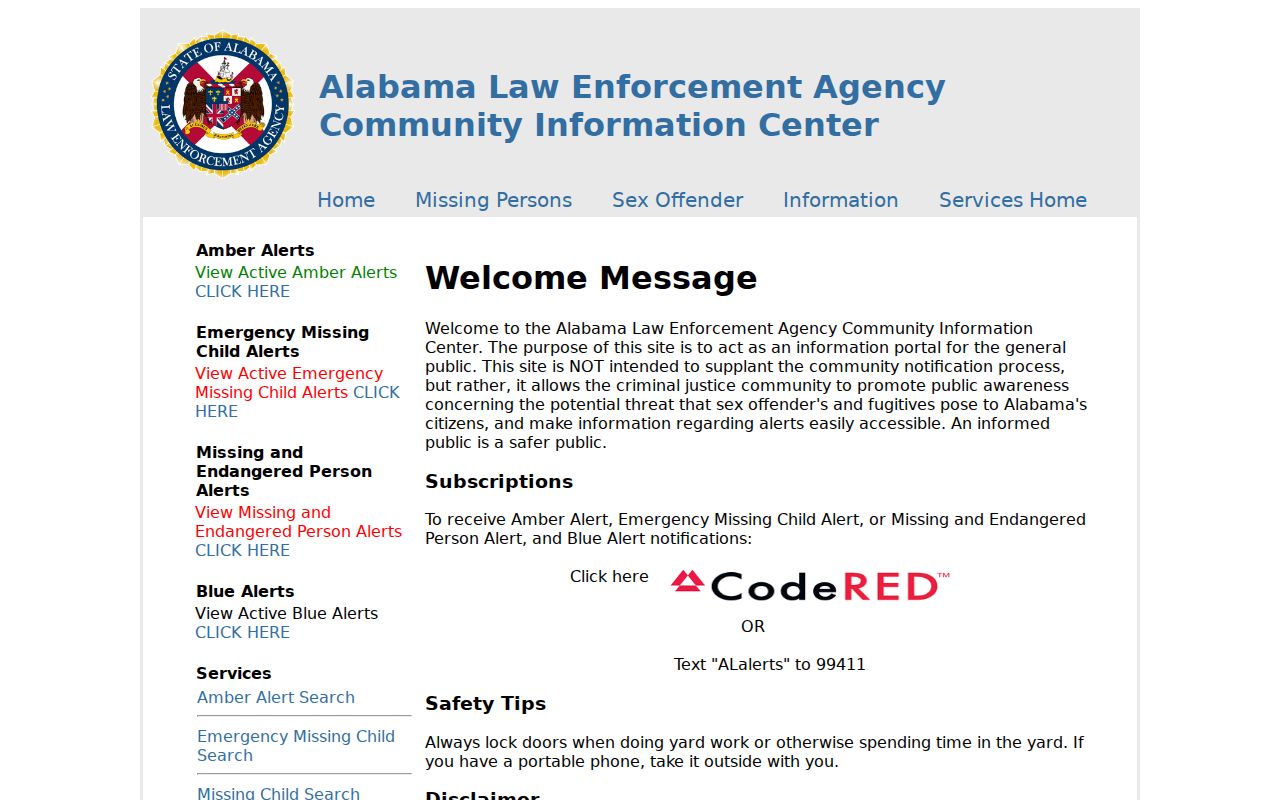
The official state route helps avoid unofficial copies that may lack a recent local update.
Searching the Alabama Law Enforcement Agency Sex Offender Registry
Start with enough location detail to limit false matches. Review the result list, then open a full profile before drawing any conclusion. Names alone can be shared, and a city label does not replace the profile's identity and offense fields.
- Open the registry from ALEA's official landing page and review its terms.
- Choose name, city or town, Talladega County, ZIP, or geographic radius.
- Compare the result list by photograph, physical details, address, and aliases.
- Open the complete entry and note the conviction history, status, and vehicle information.
| Field or mode | Type | Required | Notes |
|---|---|---|---|
| Name | Text or name | Unspecified | Statutory search path |
| City/Town | Text or select | Optional | Narrows a local area |
| County | Dropdown | Optional | Choose Talladega County; exact live options were inaccessible |
| ZIP | Text | Optional | Searches a postal area |
| Geographic Radius | Dropdown | Optional | Exact radii were inaccessible |
| Map/list controls | Interface | Unspecified | Use the current live labels |
Talladega County Registry Updates
ALEA says more than 16,000 offenders are held in the repository, but that statewide total is not a Talladega County count. The useful local point is how information moves. A local agency verifies a registrant's facts and sends changes to ALEA. The state then publishes qualifying information through its public registry. ALEA describes updates as daily and in real time from local reports.
If a Talladega County address seems wrong, save the profile details and report the concern to local law enforcement. Do not confront the person or household. ALEA also lists its registry unit at 334-676-7898 and sexoffenderunit@alea.gov. A stale address may reflect reported noncompliance, so the correct response is an official report, not an assumption about a web delay.
The ALEA online services directory gathers the state's public service entry points.
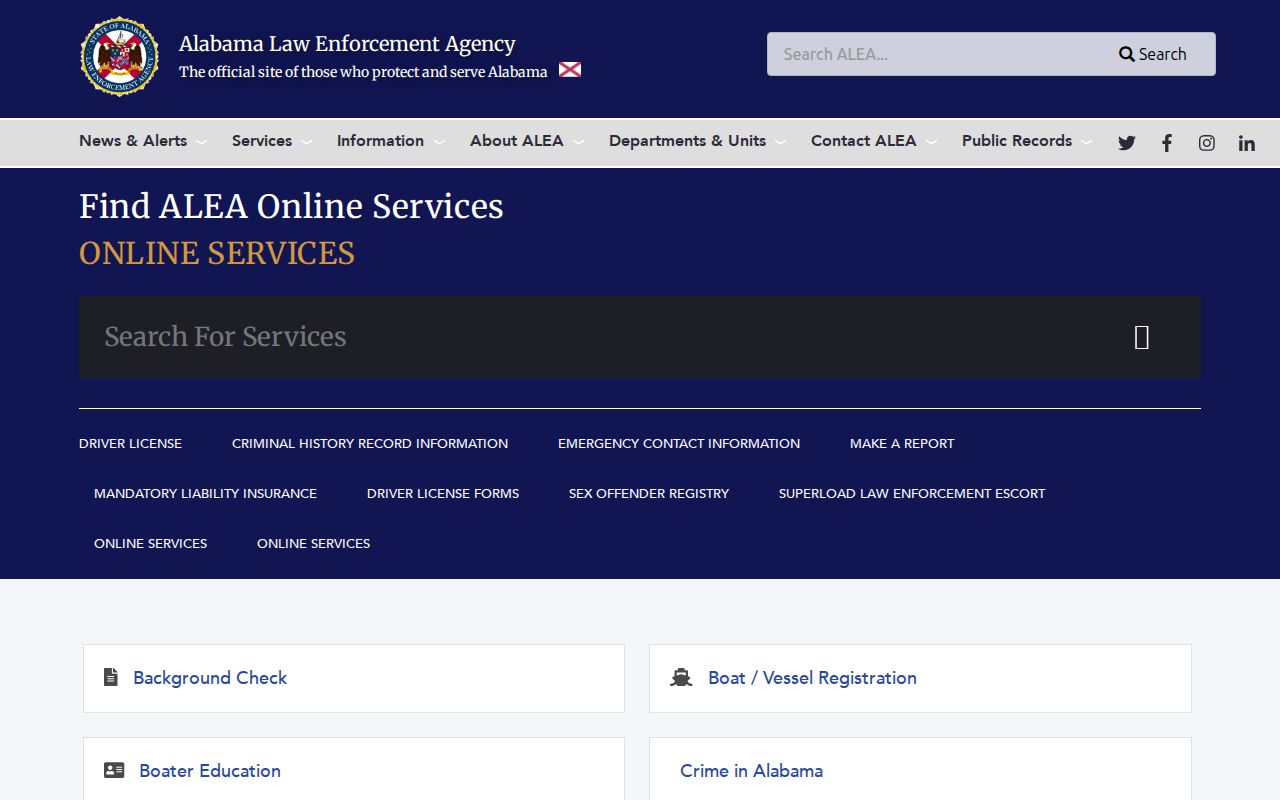
Using that official directory keeps the search tied to Alabama's current public system.
What a Registry Profile Shows
Alabama's public profile is broad but defined. It identifies the registrant and gives the facts required for notice. It does not publish every piece of information held by an agency. Read each field in context because inclusion is set by statute and does not amount to an individual danger rating.
| Name and Aliases | Legal name and known aliases used to distinguish the person. |
|---|---|
| Photo and Description | Current photograph and identifying physical traits. |
| Addresses | Residence plus school and employer addresses where public display applies. |
| Vehicles | Descriptions and plates for work or personal land, air, and watercraft. |
| Offense History | Qualifying conviction or adjudication history and offense-law text. |
| Status | Registration or absconded information made public under state law. |
Nonconviction arrests, Social Security numbers, victim identities, travel or immigration numbers, email or instant-message identifiers, and internet-service data are excluded. Those limits protect sensitive facts while keeping the legally required notice fields public.
The official text of Ala. Code §15-20A-8 sets the public information rules.
The statute explains why a public profile contains some agency facts but omits others.
Missing Talladega County Registry Results
A common mistake is treating a public-search miss as proof of no prior case. Alabama states that juvenile status, Youthful Offender status, and some out-of-state circumstances can limit public display. The registry also excludes nonconviction arrests. That means the public list and a court file have different scopes.
Search spelling variants and aliases when the profile offers them. Try county, city, ZIP, or radius modes if a name search is uncertain. If the question concerns a specific prosecution or disposition, use the court channel instead of forcing the registry to answer it. The broader Talladega County criminal history overview separates court, jail, repository, and registry sources.
Note: Absence from the public registry does not establish absence of every sex-offense adjudication or restricted record.
Registration Requirements and Levels in Alabama
Alabama does not use adult public Tier I, Tier II, and Tier III labels as its controlling scheme. Adults generally report for life and verify in person during their birth month and every three months afterward. State law sets a $10 fee for each quarterly appearance. Juvenile and Youthful Offender treatment differs by age, adjudication, history, and court findings.
| Category | Duration and public treatment | Verification |
|---|---|---|
| Adult | Life; public when §15-20A-8 applies | Birth month and every three months thereafter |
| Serious juvenile, age 14+ | Life; possible petition after 25 years; risk assessment applies | As required by the juvenile scheme |
| Other juvenile | Ten years; court sets low, moderate, or high notification | Set under the juvenile order |
| Youthful Offender | Varies with age and prior history; not automatically public | Depends on the governing status |
These categories explain duration and public treatment. They should not be converted into an informal risk score. ALEA warns that listing itself is not an individualized assessment of present danger.
Quarterly verification is an ongoing in-person duty, not a new public tier assignment. The $10 appearance fee attaches to each quarterly visit under the cited Alabama rules. A searcher should therefore read the category, duration, and public status shown by official sources instead of assigning a familiar tier label from another state. Different rules for adults, juveniles, and Youthful Offenders are part of Alabama's own statutory structure.
Talladega County Notification Distances
Talladega, Sylacauga, and Lincoln each exceed 5,000 residents under the cited Census profile, so Alabama's 1,500-foot community-notification radius applies in those three cities. Smaller areas use a 2,000-foot notification radius. Schools and day-care facilities within three miles receive notice. These are notice rules, not a promise that every nearby person appears in a given map view.
Adult residence restrictions are a separate part of the scheme. An adult registrant generally may not reside within 2,000 feet of a school, child-care facility, former victim, or the victim's immediate family under Ala. Code §15-20A-11. Searchers should keep notification distance, residence limits, and registry radius tools distinct.
Talladega County and NSOPW
ALEA is the direct source for Alabama registry details. The U.S. Department of Justice National Sex Offender Public Website adds a cross-state layer. It is useful when a search involves a move, an unknown state, or several jurisdictions. Its results still depend on the public data supplied by participating jurisdictions.
The national search is not a substitute for reporting a Talladega County address concern to local law enforcement. It broadens geographic reach, while ALEA remains the state source and local agencies remain responsible for registration facts sent to the state.
The NSOPW search screen shows the federal cross-jurisdiction route.
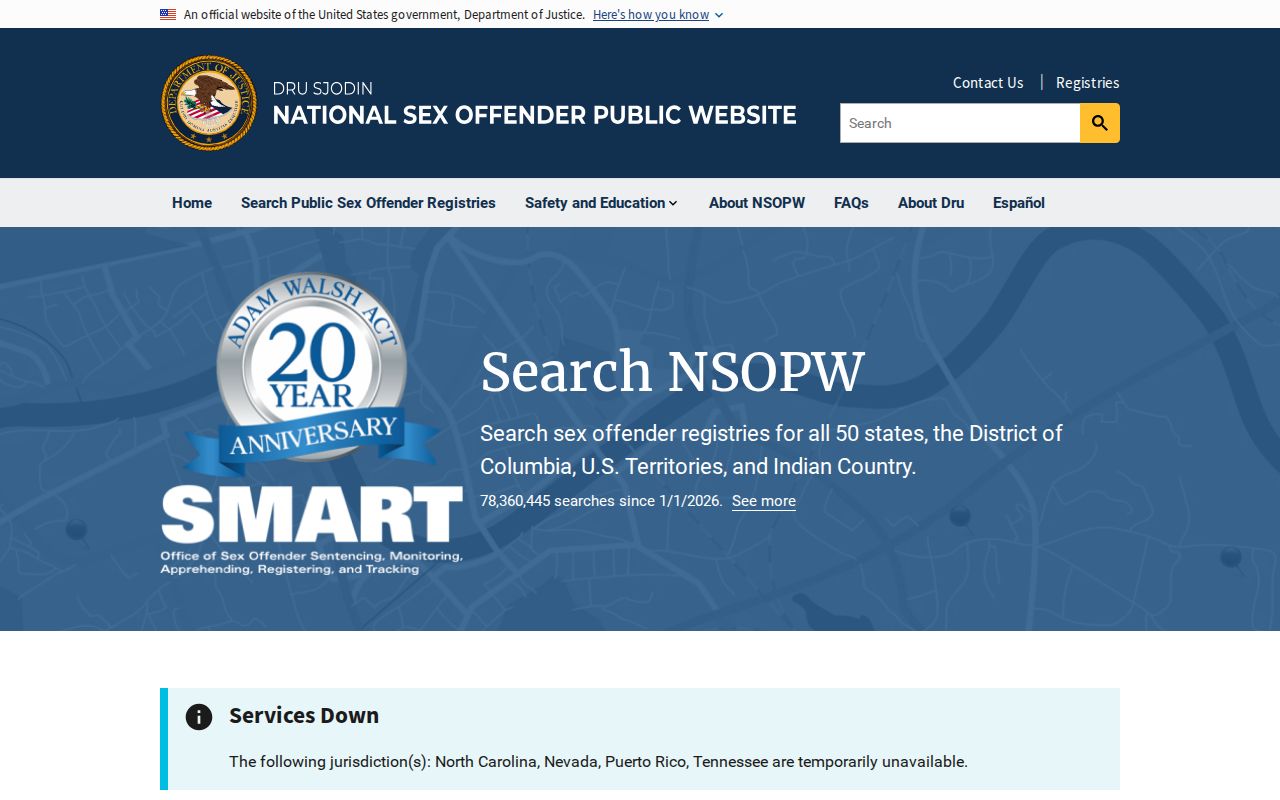
Checking both layers can help when the relevant location extends beyond Alabama.
Lawful Use and Community Notification
Registry information exists for community awareness and safety planning. It should be used to understand public notice, confirm an official listing, and decide whether to contact law enforcement about a possible error or noncompliance. It is not permission to confront, threaten, shame, or target a listed person or the person's household.
Alabama warns that misuse to injure, harass, or commit another crime can lead to civil or criminal penalties. A profile is also not a finding about current intent. Use the published facts, observe the legal limits, and route safety concerns to the proper agency.
For a possible emergency, contact law enforcement. For a data concern, provide the official profile and the disputed address or status. That keeps the matter in the hands of an agency that can verify the registration record.
Registry misuse is unlawful: Ala. Code §15-20A-8 supports civil or criminal penalties when registry information is used to injure, harass, or commit a crime.