
Criminal Cases in the Talladega County Courts
Talladega County is Alabama's Twenty-Ninth Judicial Circuit. The official county court site separates Circuit Court, District Court, and the municipal courts by the work each one performs. Circuit Court hears felony prosecutions. District Court hears misdemeanors, most state traffic matters, and preliminary proceedings in felony cases. A city municipal court keeps ordinance and qualifying state-law cases that began in that city.
The court level matters because the Talladega County criminal case file stays with that court's clerk. A felony may begin with a complaint and a District Court preliminary stage, then move to Circuit Court after indictment. A city misdemeanor may never enter the county's state-court docket. The public file can show charging papers, hearings, rulings, financial entries, the outcome, and sentence. Grand-jury deliberations are not part of the open case file.
Talladega County Felony and Misdemeanor Courts
A simple court-level check prevents many failed searches. Under Ala. Code §12-11-30, Circuit Court has felony jurisdiction. District Court authority under §12-12-32 includes misdemeanors and felony preliminary work, while municipal jurisdiction arises under §12-14-1. The charge shown at booking may be broad or may later change, so the court where a prosecution was filed is more useful than the intake label alone.
| Case level | Talladega County route | Best record |
|---|---|---|
| Felony | Circuit Court, sometimes after a District Court preliminary stage | Circuit docket and final order |
| Misdemeanor | District Court, subject to municipal jurisdiction | District or municipal docket |
| Municipal charge | Issuing city's municipal court | City court file |
| State traffic | Usually District Court | District traffic docket |
A historical local snapshot reported 837 new circuit-criminal matters and 1,705 district-criminal matters in 2019. Those figures show why division and case type help narrow a search, but they are not current caseload counts.
How to Search Case Records
The Alabama Administrative Office of Courts links to Just One Look, the on-demand trial-court system. It advertises criminal, civil, small-claims, state-traffic, domestic-relations, and child-support coverage. Access requires signup or login and payment. A name or case-number search costs $9.99 and includes one case detail. A no-match search still counts, so a known case number is the soundest starting point.
- Decide whether the case is state, municipal, or federal before paying for a search.
- Use the case number when known. If using a name, compare court, dates, and charge context before treating a result as a match.
- Open the detail and read the status, actions, settings, parties, financial history, and case-action summary.
- Use the separate docket search for a date-based court calendar, choosing Talladega County and adding a last name if helpful.
- Contact the correct Talladega County clerk for a certified disposition, purchased copy, archived file, or case absent online.
| Field label | Type | Required | Format note |
|---|---|---|---|
| Search type | Name or case number | Yes | Exact gated name fields are not public before login |
| County | Dropdown | Yes on docket search | Select Talladega |
| Setting Date | Date | Used for docket list | Returns the chosen court date |
| Last Name | Text | No on docket search | Blank requests the whole docket |
Just One Look does not publish its exact gated name-field labels before login. Avoid inventing filters that are not shown. The separate docket form is the verified route for county, setting date, and optional last name.
Talladega County Court Search Limits
The portal's own warning says some cases may not appear electronically. That makes online absence a clue, not a final answer. Older Talladega County criminal records, sealed matters, municipal files, and a case entered under unexpected name details may require a clerk check. Purchased images cost $5 for the first 20 pages and $0.50 for each page after that. Lifetime monitoring is advertised at $19.99 for a district case and $29.99 for a circuit case.
The Just One Look source screen shows where the statewide Talladega County case search begins.
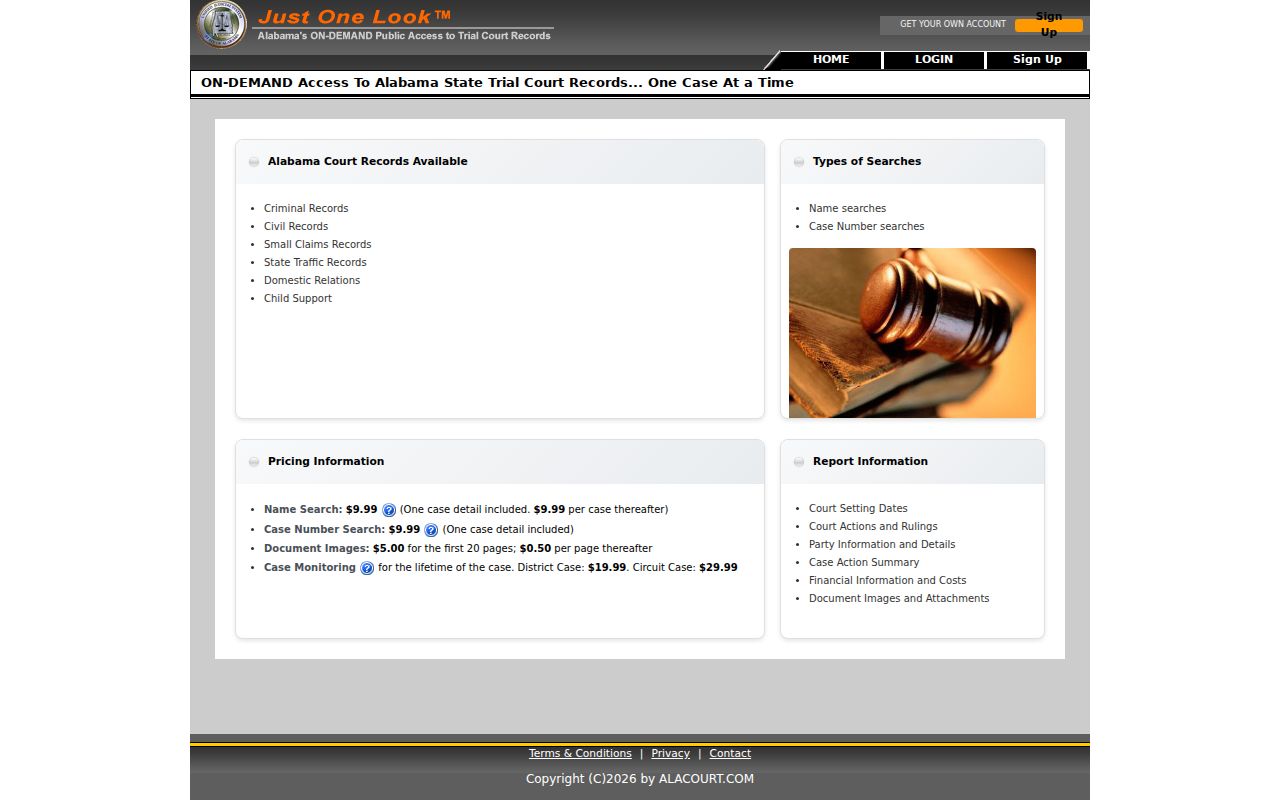
The screen represents a paid access point to court data, not a guarantee that every document or every Talladega County municipal case is online.
Note: A no-match search still carries the stated search charge, so confirm spelling and court level before submitting it.
What the Case File Shows
A Talladega County case file is case-centered. It records what prosecutors filed and what the court later did. That differs from an ALEA repository record, which organizes fingerprint-supported arrest cycles, and from a jail entry, which focuses on intake and release. For a final outcome, read the judgment or disposition rather than the first charge displayed on the docket.
| Case Number & Court | Identifies the court, division, and individual prosecution. |
|---|---|
| Charging Document | Shows the complaint, information where allowed, or indictment filed in court. |
| Docket Entries | Lists filed papers, court actions, rulings, and the case-action history. |
| Hearing Dates | Shows settings such as arraignment, motion hearings, plea, or trial. |
| Disposition & Judgment | States whether a count ended in conviction, dismissal, acquittal, or another result. |
| Sentence & Conditions | Records punishment, costs, restitution, probation, and other ordered terms when public. |
Public views may also include parties, financial history, and purchased attachments. Protected identifiers, victim information, juvenile and Youthful Offender material, and content sealed by rule, statute, or order can be removed or withheld.
Talladega County Criminal Clerk Divisions
Talladega County has two judicial counters, and calling the wrong one can slow a record request. The official clerk directory places circuit-criminal staff and Northern Division district-criminal staff in Talladega. Southern Division district-criminal staff work in Sylacauga. Both publish weekday hours of 8:00 a.m. to 4:30 p.m.
Northern Division
148 East Street North
Talladega, AL 35160
Circuit Criminal: 256-761-2102, extensions 1202, 1205, or 1206
District Criminal: 256-761-2104, extension 1210
Southern Division
400 North Norton Avenue
Sylacauga, AL 35150
District Criminal: 256-245-4352, extension 2037
Monday through Friday, 8:00 a.m. to 4:30 p.m.
Give the clerk a case number if possible. Ask about public copies, certification, archived material, and the current charge before requesting reproduction because the county directory does not publish those fees.
Stages of a Criminal Case
A Talladega County felony record may start with a complaint, warrant, or warrantless arrest. An initial appearance addresses identity, the accusation, rights, counsel, and release conditions. District Court can hold the preliminary stage. If a grand jury returns an indictment, the Circuit Court file then carries arraignment, motions, settings, plea or trial, judgment, sentence, and any notice of appeal.
Case flow: Charges Filed › Arraignment › Pretrial › Plea or Trial › Disposition › Sentencing
Not every Talladega County criminal case takes each route. A prosecutor may decline to continue a charge, a court may dismiss it, or a plea can resolve it without trial. Court dispositions are then reported to ALEA, but transmission lag can cause the court file and repository record to differ for a time.
Reading Talladega County Case Outcomes
Outcome terms carry precise meanings. A closed file only means the court entered an outcome. It does not itself mean guilt. A pending file lacks a final disposition. The Talladega County clerk's final order is the best source when a short docket label seems unclear or when an arrest charge differs from the prosecuted count.
- Disposition
- The recorded outcome, such as conviction, dismissal, acquittal, or nolle prosequi.
- Nolle prosequi
- The prosecutor formally declines to continue the charge at that time.
- Acquittal
- A not-guilty verdict or judgment after adjudication.
- Dismissal
- The charge ends without a judgment of guilt, though the record does not automatically vanish.
- Conviction
- A judgment of guilt after a plea or trial.
If an ALEA self-review record lacks the Talladega County outcome, obtain a certified disposition or case-action summary and use ALEA Form 46 Appendix A. Supporting court papers help tie the correction to the proper fingerprint-supported arrest cycle.
Access & Restrictions
Alabama's Open Records Act supplies a general right to inspect and copy public writings, while Alabama court-record privacy rules preserve public access unless a law, rule, or order restricts the material. Remote access is not all-access. Fees may apply, and a clerk may redact protected data from a copy.
Juvenile records, Youthful Offender matters, expunged or sealed content, protected identifiers, victim information, and other confidential categories are not made public merely because the rest of a case is open.
ALEA repository information has separate dissemination limits under Ala. Code §§41-9-590 and following. Public Talladega County court access does not create a right to another person's fingerprint record. For one's own Alabama history, the official path is the fingerprint-based ALEA personal-review process.
When a Talladega Court Case Is Missing
First check the court level. A Talladega Municipal Court matter may not appear with Circuit and District Court records. Next check whether the search used the right spelling, division, and case number. The portal says some matters may not be electronic, so call the correct clerk rather than assuming no case exists.
Federal prosecutions are separate too. Talladega County lies in the Northern District of Alabama, and federal dockets use PACER. Federal custody at FCI Talladega appears through the Bureau of Prisons, not the state trial-court portal. A county arrest that later led to a state prosecution can be followed from the booking record to the Talladega County arrest history source, then back to the clerk for the final court result.
Note: A missing electronic result does not prove that no court file, municipal matter, sealed case, or older record exists.